Telefono: 379 14 89 430
Orari: Monday to Friday, 9:00 a.m. to 6:00 p.m.



Telefono: 379 14 89 430
Orari: Monday to Friday, 9:00 a.m. to 6:00 p.m.
AI, CV, and Spectroscopy for Waste Management – Part 2
19 May 2025
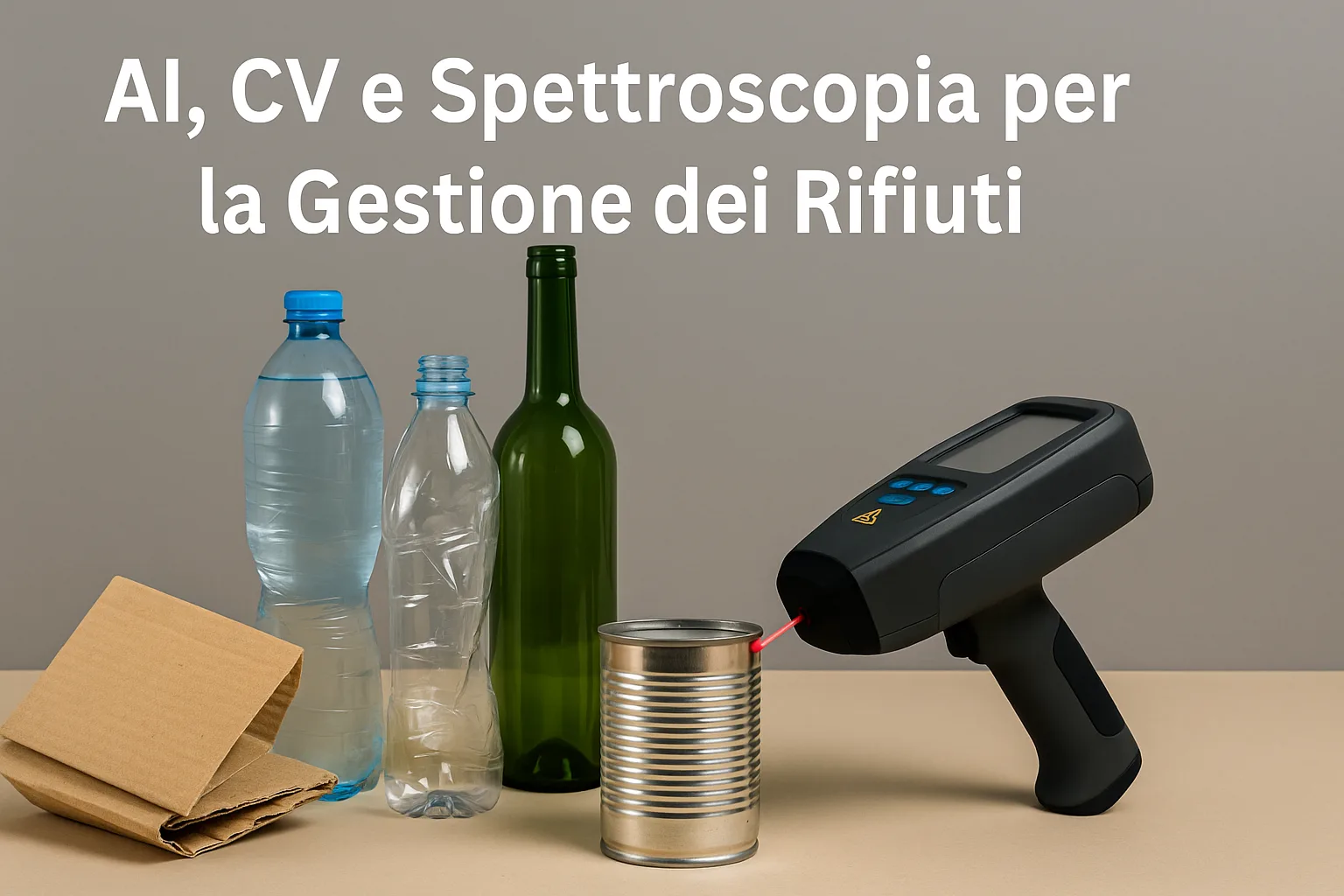
Automating Waste Sorting: From Theory to Practice with Mechatronics
In the previous article, we left off with a realistic outline of the application logic for automated waste sorting. Now it’s time to start understanding concretely how this system can become automated. Let’s now enter the fascinating world of mechatronics and robotics.
To save time in manually sorting waste, the first thing I envision is a container where various scraps can be freely thrown in. From there, each piece of waste will need to be automatically transferred to the chamber where the analysis through Raman spectroscopy will take place.
There are various solutions for transporting the waste, and here a crucial decision for the project arises: do we want to aim for a practical compromise, or do we wish to handle every single type of waste with absolute precision? If we choose the simpler route and accept some compromises—such as limiting ourselves to rigid containers like cartons and bottles—a conveyor belt equipped with paddles might be sufficient.
If, on the other hand, we opt for a more versatile solution—one that allows us to identify and handle any object regardless of its shape or size—then it will be necessary to implement a robotic arm equipped with computer vision, capable of recognizing and selecting each item before placing it on the conveyor belt.
For this project—and also with the goal of creating a truly eco-friendly product—we choose this latter solution. However, we decide to exclude the handling of organic waste, in order to avoid additional technical complications such as the need for continuous washing of the conveyor belt, which would also require the electronic components to be designed with a protection rating of at least IP65.
Device mechanics
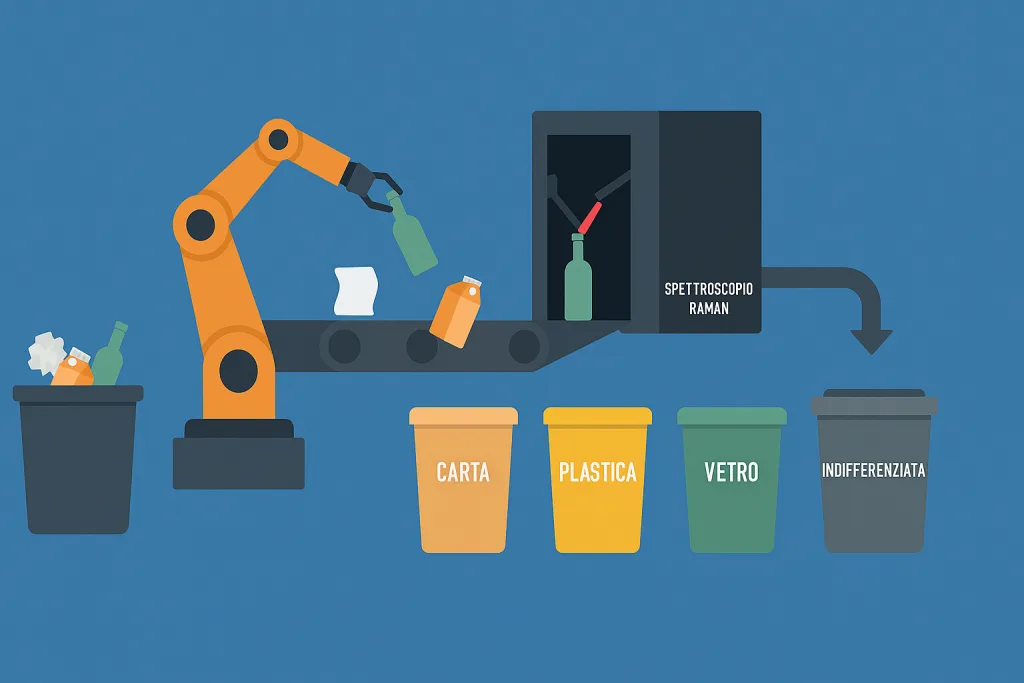
Let’s imagine having an initial bin containing different types of waste. A robotic arm, equipped with a camera, visually analyzes the waste, identifies it, picks it up, and places it on a conveyor belt. This conveyor belt transports each object into a dark chamber where our Raman spectroscope is positioned. The spectroscope identifies the material and, based on the result, activates a path selector: plastic will end up in the plastic bin, glass and metal in their respective containers, and paper in the bin dedicated to paper.
A brief personal note
When I started describing this project, it seemed relatively simple and straightforward. However, after careful consideration, it turned out to be anything but simple. It’s fascinating to note how a task that seems so immediate and simple in everyday life actually requires a complex combination of technical knowledge.
Along this journey, we will explore together how to tackle these challenges and transform an initial idea into a truly functional and useful final product—open-source and accessible to everyone, provided they have the necessary equipment to create the parts required to bring the product to life.
In the next article, we will cover the design and 3D printing of the various components that will make up our transport element.
[starbox]
Author

Simone Renzi
CEO at RENOR & Partners
Latest published articles
Tuesday, 29 September 2026
Cloud Migration Consulting for Companies in Italy: Selection Guide
Why more and more Italian SMEs are migrating to the cloudFor years, many small and medium-sized Ital...
Pubblicato da Simone Renzi
Tuesday, 22 September 2026
Serverless Application Development for Enterprises: Strategic Guide to Benefits
What "serverless" means (explained without the jargon)The term "serverless" is o...
Pubblicato da Simone Renzi
Tuesday, 15 September 2026
Development of a Custom Cloud Platform for SMEs: Practical Guide
Why should an SME choose a custom cloud platformMany small and medium-sized businesses start with st...
Pubblicato da Simone Renzi
Potrebbero interessarti anche
Monday, 10 August 2026
AI Prototype and Proof of Concept for businesses: costs and how they work
What is an AI proof of concept and why you should start hereAn AI proof of concept (PoC) is a scaled-down, targeted version of an ...
Pubblicato da Simone Renzi
Sunday, 09 August 2026
Computer vision in industry: how it works and project costs
What is computer vision and why it matters to manufacturing companiesComputer vision is the technology that allows a computer to &...
Pubblicato da Simone Renzi
Monday, 03 August 2026
Process Automation with AI for SMEs: What Does It Really Cost
What It Means to Automate Processes with AI in an SMEAutomating a process with artificial intelligence means delegating certain re...
Pubblicato da Simone Renzi
Sunday, 02 August 2026
Custom AI Agents for SMEs: Real Costs and Investment Evaluation
What Custom AI Agents Are and Why They Matter for SMEsWhen people talk about AI agents, many immediately think of a chatbot answer...
Pubblicato da Simone Renzi
Tuesday, 28 July 2026
Custom AI Chatbot for Businesses: Pricing and Quote Request
Why a custom AI chatbot (rather than a generic one) makes a difference for your businessOff-the-shelf generic chatbots can answer ...
Pubblicato da Simone Renzi
Monday, 27 July 2026
Scalable AI cloud solutions for businesses: how to read and request a quote
What does "scalable AI cloud" mean for a business (in plain language)Behind a term that sounds complicated are three fai...
Pubblicato da Simone Renzi